High Noise Communication
 Respirators & PAPR Communication
 HazMat & In-Suit Communication
 Intrinsically Safe Communication
 Air Traffic Control/Emergency Dispatch
 Construction Communication
 Commercial/Business Communication
 Plant Tours & Training
 Schools & Higher Education
 Workplace Hearing Protection
 Hearing Protection For Recreation & Home
 TeamTalk Hands-Free Communication
 Talk Through Your Ears®
 RadioGear® Earsets
 Headsets
 Custom Hearing Protection
 Filtered Hearing Protection
 Fit Testing
 Hytera Radios
 Horizon Push-To-Talk Over Cellular
 Hytera Repeater Systems
 Kenwood Radios
 Maxon Radios
 RCA Radios
 Full-Duplex TeamTalk™
 CavCom Accessories
 Lapel Speaker Mics
 Radio System Design and Development
 Radio Licensing, Programming & Repairs

One-Sided Hearing Loss - a Warning Sign
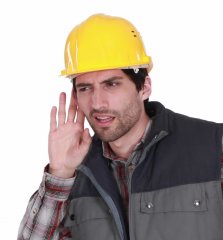 CavCom hears from customers concerned about a significant hearing loss or Standard Threshold Shift (STS) that shows up in only one ear. Is this common with occupational noise exposure? Not typically. In fact, a shift in only one ear can be a warning sign.
No amount of hearing loss is acceptable. In particular, a significant change in one ear that is much larger than the other ear is unusual and in need of follow-up. If you see a high number of one-sided shifts among your workers, especially within one department or work group, it deserves a closer look at your overall program.
Why noise-induced hearing loss is usually symmetrical
In most workplaces, both ears are exposed to similar sound levels at the same time. Even when noise seems to come mostly from one side, workers turn their heads and move around throughout the day. The two ears are also close together, and most sound waves bend easily around the head to reach the far ear, especially in reverberant spaces. Most well-controlled research studies show that hearing loss in noise-exposed workers is usually similar in both ears.
Common causes of one-sided hearing loss
Because of this, a significant difference between the ears calls for special review and follow-up.
First, medical conditions or an ear or head injury can cause one-sided hearing loss, ranging from mild to serious in nature. In these cases, medical evaluation and treatment is critical.
Common noise-related causes may include the following, and also require follow-up and problem-solving:
- Impulse noise such as gunfire and explosions. Impulse sounds pack a lot of energy into a very short burst, with peaks that often exceed 140 dB SPL. The sound is typically directional, so most of the damage lands on the ear closer to the source. This pattern is well documented in shooters. For a right-handed rifle shooter, the left ear is closer to the muzzle and typically shows more loss. The same pattern can appear in people exposed to explosions or other loud impulse sounds.
- A poorly fitted hearing protector, or no protector, in one ear. Ears vary in size and shape, so a hearing protector must be fitted individually for each ear. A different size may be required for an individual's left and right ear. Next, some users find it harder to insert an earplug correctly in one ear than the other. Worse yet, some workers remove one earplug or lift one earmuff cup because they feel the protector makes it harder to hear their machine or coworkers. That belief, and failure to consistently wear hearing protection in both ears, points to a communication problem that needs solving.
- Single-ear headsets. Some headsets and earbuds don't limit their output, so at high volume settings they can add a significant noise dose. Listening with only one ear also tends to require a higher volume to understand speech. A worker who wears an unlimited headset or earbud in one ear, or clips a speaker mic to one shoulder without adequate hearing protection, may develop a hearing shift in that ear.
What to do when you see a unilateral (one ear) shift in hearing
Any hearing shift calls for prompt follow-up with the individual worker. When you see a pattern of shifts, evaluate the entire hearing conservation program. Best practices include:
- Professional review and referral. Medical/audiological review should include a case-by-case evaluation to determine if an event/exposure in the workplace caused or contributed to the change in hearing and if medical follow-up is needed.
- Individual counseling and retraining. Take time to understand each employee's concerns or objections about wearing hearing protection. Correct any misconceptions, ease worries about communicating safely, and provide communication solutions that fit the job and work with other PPE. Also counsel employees about off-the-job noise, such as hunting and recreational activities, and the importance of protecting their hearing at home as well as at work.
- Hearing protection fit testing. Individual fit testing is a vital part of an effective hearing conservation program, not a luxury. For workers who have shown a shift in hearing, fit testing can reveal how much protection they receive and even small differences in fit or insertion between the ears. It also lets you refit and retrain workers on the spot, to improve hearing protector effectiveness going forward.
- Appropriate specifications for communication headsets. To support effective communication while simultaneously protecting hearing, vet communication headsets and earsets carefully. Require these key features:
- Integrated hearing protection. When in high noise, the communication device must sufficiently block workplace noise; a good seal of the ear/earcanal is essential. For best results, choose a design with the microphone and/or receivers built into the hearing protector. This way radio signals go directly to the ear while outside noise stays out.
- Binaural (two-ear) listening. The auditory system works best with input from both ears. The brain compares the signals from each ear to localize sounds, understand speech, and separate speech from background noise. As a result, radio transmissions and other signals don't need to be as loud when heard with both ears. Preferred listening levels are typically 3 to 6 dB lower when listening with both ears than with one, which means more comfortable and, most importantly, safer volume settings.
- Volume-limited output. Whether a worker is in a quiet or noisy area, the signal from a headset shouldn't add to their noise exposure. Make sure any communication headset you buy limits output to safer levels. A binaural design adds to this benefit, since most users will choose a lower volume than they would with a single-ear device.
At CavCom, we're committed to assisting you find solutions for your toughest listening challenges. Contact us if we can help with your communication systems or your hearing conservation program.
To learn more:
- CavCom, How to Achieve Clear Two-Way Radio Communication in High Noise Industrial Environments
- CavCom, Choosing Hearing Protectors
- CavCom, The Complete Guide to Custom Hearing Protectors
- Dobie, Robert (2014). Does occupational noise cause asymmetric hearing loss? Ear & Hearing, Vol 35(5).
- Guest et al. (2026). Leveraging Monaural Exposures to Reveal Early Effects of Noise: Evidence from Police Radio Ear-Piece Use, Trends in Hearing, Volume 30: 1–15.
- Masterson et al. (2016). Asymmetrical hearing loss in cases of industrial noise exposure: a systematic review of the literature, Otology & Neurotology, Vol 37.
| Categories: | Hearing & Hearing Loss, Hearing Conservation Programs |